Creating new worlds through the power of molecular AI
Researchers have been pushing molecular boundaries at the Beckman Institute for nearly 40 years.
Today, they’re harnessing the power of artificial intelligence to continue that tradition, in pursuit of curing diseases, better capturing solar energy and making materials that are sustainable and easy to reproduce.
Researchers have been pushing molecular boundaries at the Beckman Institute for nearly 40 years.
Today, they’re harnessing the power of artificial intelligence to continue that tradition, in pursuit of curing diseases, better capturing solar energy and making materials that are sustainable and easy to reproduce.

PolyPrinting the future
Professor Ying Diao’s lab uses AI in many ways, including in understanding chirality, a property where structures have a distinct left- or right- “handedness.” It allows natural semiconductors to move charge and convert energy with high efficiency by controlling electron spin and the angular momentum of light.
At Beckman, her autonomous PolyPrint lab is building two robotic systems to manufacture functional polymers through printing, which is known in the lab as additive manufacturing.
Robot Larry will autonomously print photonic materials. Robot Make Make will print organic electronic devices such as solar cells, electrochromics (materials that change color when electrically charged), transparent conductors and spintronic devices (which use the quantum spin of electrons rather than just their charge to process, store and transmit information).
Members of Ying’s lab use AI for rapid prototyping of new modules for the robots. These include a polarized optical microscope and semiconductor analyzers.
They also use it to guide closed-loop materials development, along with professors in collaboration with Marty Burke, Nick Jackson, Heng Ji and their groups. The AI makes suggestions to the robots about how to optimize the material, such as in the print quality or the device’s properties. The robots try the recommended condition and report back to the AI to refine the idea. The AI then suggests new parameters to try, until they’ve solved the problem.
PolyPrinting the future
Professor Ying Diao’s lab uses AI in many ways, including in understanding chirality, a property where structures have a distinct left- or right- “handedness.” It allows natural semiconductors to move charge and convert energy with high efficiency by controlling electron spin and the angular momentum of light.
At Beckman, her autonomous PolyPrint lab is building two robotic systems to manufacture functional polymers through printing, which is known in the lab as additive manufacturing.
Robot Larry will autonomously print photonic materials. Robot Make Make will print organic electronic devices such as solar cells, electrochromics (materials that change color when electrically charged), transparent conductors and spintronic devices (which use the quantum spin of electrons rather than just their charge to process, store and transmit information).
Members of Ying’s lab use AI for rapid prototyping of new modules for the robots. These include a polarized optical microscope and semiconductor analyzers.
They also use it to guide closed-loop materials development, along with professors in collaboration with Marty Burke, Nick Jackson, Heng Ji and their groups. The AI makes suggestions to the robots about how to optimize the material, such as in the print quality or the device’s properties. The robots try the recommended condition and report back to the AI to refine the idea. The AI then suggests new parameters to try, until they’ve solved the problem.
Artificial Intelligence for Materials moving research beyond trial-and-error
Artificial Intelligence for Materials moving research beyond trial-and-error
Members of Beckman’s AI for Materials working group are dissolving the traditional barriers between computation and experiment by putting AI at the core of their research efforts.
This attitude allows the group to access new molecular design frontiers beyond traditional scientific frameworks that focus on a few variables at a time.
“We are embracing the high-dimensionality of real, complex systems and leveraging automated synthesis and materials characterization to obtain large quantities of high-quality, reproducible experimental data,” said group leader Nick Jackson.
Synthesis is the combining of simpler substances to create a more complex one. Characterization is the analysis of a material’s properties: stiff, flexible, elastic or brittle.
Designing materials on a fast track
Designing materials on a fast track
Nick’s own research group focuses on developing new theoretical chemistry methods. This includes electronic coarse-graining, which simplifies computer simulated materials by grouping their atoms while still accurately predicting their electronic properties.
“AI serves as a foundational enabling tool,” he said.
Members of his lab also use AI to design new polymers. It allows them to improve material properties at the same time. They’re focused on creating polymers that can be easily replicated, ensuring that they’re not too expensive or complex to produce.
AI has dramatically changed how Nick and his fellow researchers design materials, which has been a historically slow process.
“AI enables one to flip this entire paradigm on its head,” he said. “We can target multiple properties simultaneously. It’s critical for accelerating progress in solving urgent global challenges, such as developing sustainable organic electronics.”

Autonomous electrochemistry making batteries, fuel more sustainable
Electrochemistry is a discipline that aims to understand how electricity can be used to transform chemicals and how chemicals can create electricity; both processes are pillars of sustainability.
Through electrochemistry, chemical reactions can be controlled using electronic circuits, which means instruments and computer code.
Machine learning and artificial intelligence also use code, which means that their workflows can be easily integrated into Joaquín Rodríguez-López’s electrochemical autonomous laboratory at Beckman.
Beckman Institute Graduate Fellows Michael Pence and Zirui Wang have relied on advanced electrodes and machine learning to efficiently direct the autonomous laboratory toward the best conditions for carrying out reactions for renewable energy. They’re working to control the oxidation of bio feedstocks, which are a sustainable fuel source, and the characterization of battery materials to figure out how to make batteries more efficient and longer lasting.
From their first robot, which former Beckman Institute Undergraduate Fellow Nikita Lukhanin helped build, new opportunities are starting to shape their research.
“Our interdisciplinary collaborations at the Beckman Institute to integrate artificial intelligence are now taking us to greater heights in our project,” Joaquin said, “promising to make our autonomous lab more self-sufficient and more plugged in to challenges beyond our immediate expertise.”
Autonomous electrochemistry making batteries, fuel more sustainable
Electrochemistry is a discipline that aims to understand how electricity can be used to transform chemicals and how chemicals can create electricity; both processes are pillars of sustainability.
Through electrochemistry, chemical reactions can be controlled using electronic circuits, which means instruments and computer code.
Machine learning and artificial intelligence also use code, which means that their workflows can be easily integrated into Joaquín Rodríguez-López’s electrochemical autonomous laboratory at Beckman.
Beckman Institute Graduate Fellows Michael Pence and Zirui Wang have relied on advanced electrodes and machine learning to efficiently direct the autonomous laboratory toward the best conditions for carrying out reactions for renewable energy. They’re working to control the oxidation of bio feedstocks, which are a sustainable fuel source, and the characterization of battery materials to figure out how to make batteries more efficient and longer lasting.
From their first robot, which former Beckman Institute Undergraduate Fellow Nikita Lukhanin helped build, new opportunities are starting to shape their research.
“Our interdisciplinary collaborations at the Beckman Institute to integrate artificial intelligence are now taking us to greater heights in our project,” Joaquin said, “promising to make our autonomous lab more self-sufficient and more plugged in to challenges beyond our immediate expertise.”
Combining forces for the future
Joaquin and Nick’s labs are working together to launch a new AI-focused effort to automate more systems, including electropolymerization. It’s a technique for creating polymers that conduct energy directly on an electrode surface. They’re used in solar cells, batteries and chemical sensors.
“We hope to open up new frontiers into energy and biosensing applications,” Nick said.
To explore these new frontiers, Nick and Joaquin are co-advising student Abby Miller, a recent recipient of NSF’s graduate research fellowship. Abby is now putting together all aspects of electrode design, autonomous electrochemistry, and artificial intelligence to design campaigns that seamlessly bring together many disciplines.
Illinois Polymer Maker Lab automating and accelerating the development of new materials
Illinois Polymer Maker Lab automating and accelerating the development of new materials
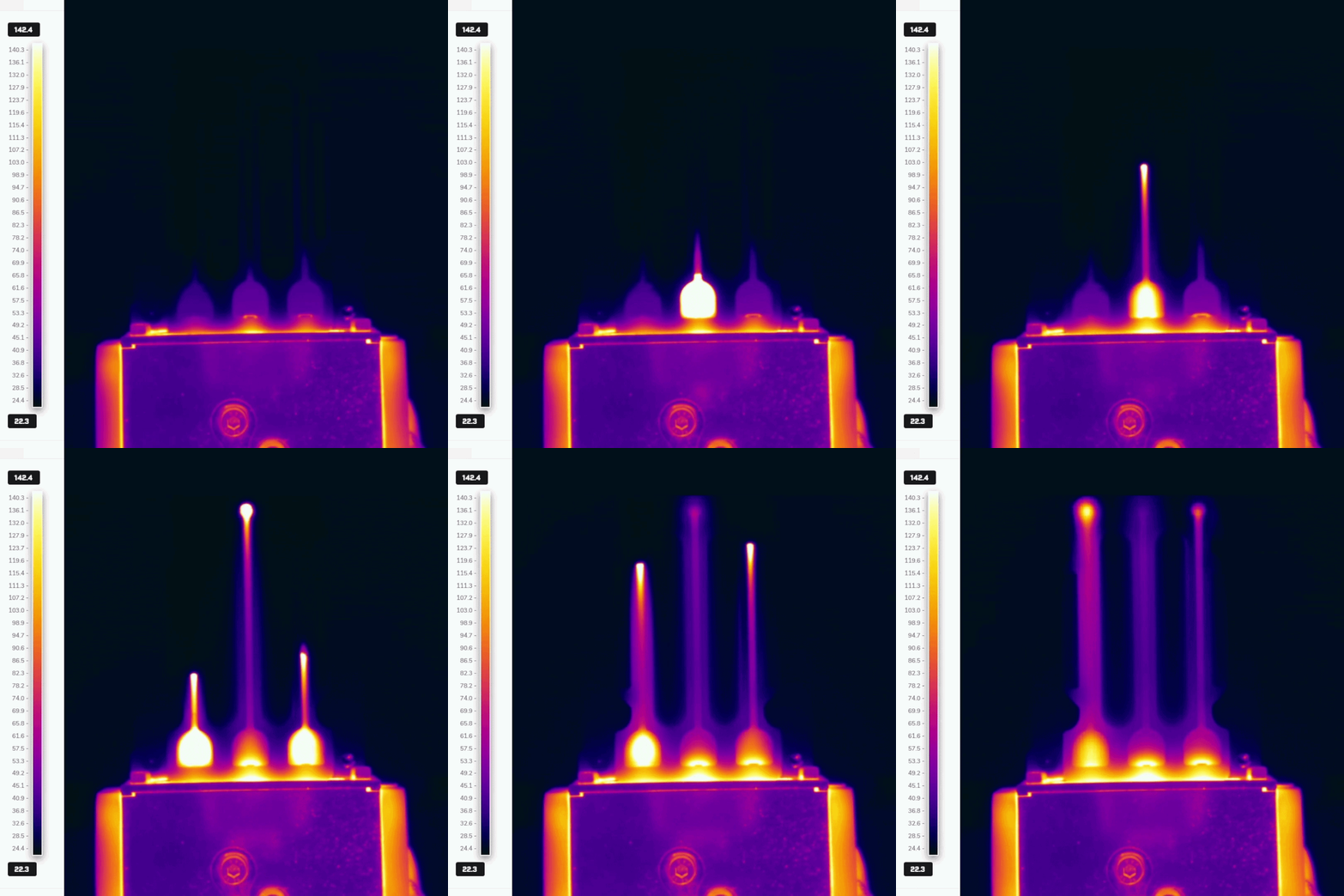
Beckman’s newest core facility, the Illinois Polymer Maker Lab, is open to researchers across campus and the world.
It’s full of equipment that allows researchers to accelerate the development of materials and products related to paints and coatings, adhesives, personal care items, composites, and materials for 3D printing. It could also help researchers design resins for energy-efficient manufacturing and products in the food science industry. It’s funded by a Major Research Instrumentation grant from the National Science Foundation.
“It provides researchers with an incredible opportunity to accelerate the development of polymer-based formulations through the creation of rich, digital datasets using automated equipment and workflows,” said lab manager Dan Krogstad.
Sam Tawfick, a co-leader of the Autonomous Materials Systems group, said his Beckman research colleagues are researching how to better manufacture advanced materials through 3D printing or resins for polymers reinforced with carbon fibers.
“IPML changes the students’ workflow in the lab by minimizing sample preparation steps and enabling the equipment to run and take measurements 24 hours a day, seven days a week. For the students, this means higher productivity and the ability to focus on interpretation of the results,” Sam said.
In the past, it’s taken up to 20 years for a new polymer, like a high temperature resistant silicone or high strength composite, to be ready for commercial use. Material readiness is ranked on a scale (called the Technology Readiness Level, or TRL) between 0 and 9, the latter which describes a material that’s commercially established.
“It takes about 10 years to move the concept of a material from TRL 0 to TRL 3 in a lab,” Sam said. “IPML is targeting this stage, with the aim of shortening it from a decade to potentially weeks.”
Fueling discovery in the Molecule Maker Lab
Fueling discovery in the Molecule Maker Lab
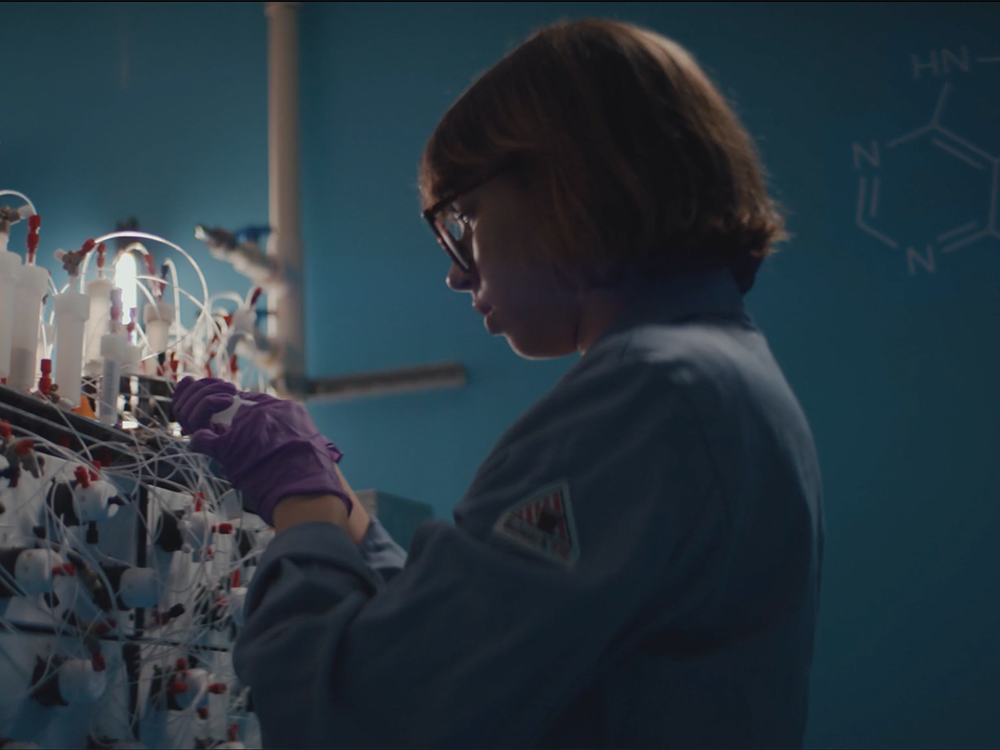
Marty Burke and his colleagues created the Molecule Maker Lab within Beckman to make chemical synthesis widely available.
Powered by a new intellectual architecture for the process of small molecule synthesis, called blocc chemistry, in concert with automation and AI, the lab allows anyone — from students to citizen scientists — to design and synthesize functional small molecules that address societal challenges.
The team developed a novel and nontoxic form of amphotericin B for invasive fungal infection. The drug is currently in clinical trials.
"We're democratizing molecular innovation, not just automating chemistry — the MML puts real molecule-making tools in the hands of people who've never had access to this innovation space before,” Marty said.
Molecular AI in the news
- Illinois Polymer Maker Lab opens with full suite of custom equipment
- Publication in Science charts a path to democratized molecular innovation
- Beckman’s new Illinois Polymer Maker Lab commissions first instrument
- Beckman researchers develop new strategy for creating recyclable, high-performance polymers
- Inspired by nature: Beckman researchers receive $2M grant to develop chiral electronics
- Beckman researchers, collaborators receive $1.8 M NSF grant to develop self-replicating materials
Have questions or want to learn more? Contact us.
Cristina Alvarez Mingote
Email: alvarez9@illinois.edu
Beckman Institute for Advanced Science and Technology