Article
Local Mechanical Properties of White Matter Structures in the Human Brain
Curtis L. Johnson
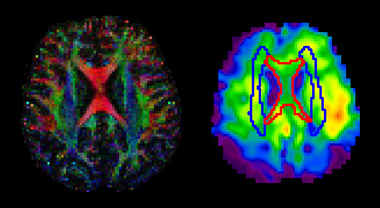
The noninvasive measurement of the mechanical properties of brain tissue using magnetic resonance elastography (MRE) has emerged as a promising method for investigating neurological disorders. To date, studies have been limited to global alterations in mechanical properties, though quantification of the stiffness of specific structures in the white matter architecture may be valuable in assessing the localized effects of disease. Localized property measurements have been limited in the past due to lack of spatial resolution, and we recently introduced a method for acquiring high-resolution brain MRE data. Here we report the mechanical properties of the corpus callosum and corona radiata measured in healthy volunteers using high-resolution MRE and atlas-based segmentation. Both structures were found to be significantly stiffer than overall white matter, and the corpus callosum exhibited greater stiffness and less viscous damping than the corona radiata. Reliability of both local and global measures was assessed through repeated experiments, and each measure exhibited excellent repeatability. Mechanical properties within the corpus callosum demonstrated high correlations with measures of underlying microstructure from diffusion tensor imaging.
Identifying neuropeptides induced by exposure to a cocaine-associated context and exercise in mice
Martina Mustroph
I recently showed that wheel running can facilitate extinction of conditioned place preference (CPP) for cocaine if running occurs after conditioning. However, mechanisms underlying CPP extinction from running are unknown. Given that the hippocampus and amygdala play an important role in contextual conditioning, it is reasonable to hypothesize that neuroadaptations from running in these regions underlie the rapid extinction of CPP. In my current research, I am determining whether the accelerated extinction of cocaine CPP is associated with altered expression of neuropeptides in hippocampus and amygdala of C57BL/6J mice. I am using state-of-the-art neuropeptidomic technology in collaboration with the Sweedler group, one of the world’s leading peptidomics laboratories. The proposed research is innovative because it uses a peptidomics approach to identify known and novel neuropeptides that interact with running and cocaine reward. Once these neuropeptides are identified, developing effective treatments to help maintain abstinence from drug addiction may become possible.
Enhanced Breast Cancer Therapy with DNA Aptamer-Functionalized Liposomes
Hang Xing